
Carbon Press Publishing

READ : 13 MINS
PLAY ARTICLE
The Great Erasure: Moors, Jacobites, and the Whitewashing of the West - Part 1
CARBON PRESS
KNOWLEDGE
A PLATFORM FOR IDEAS
A STANDARD FOR DISCOURSE
THURSDAY, 1st JULY, 2026
T
o whom it may concern. The conventional historical narrative presented in modern academic curricula paints an absolute partition between the classical civilizations of
Africa and the royal, aristocratic lineages of Western Europe [Walker 2006].
This systemic separation, engineered during the eighteenth and nineteenth centuries, serves a profound geopolitical purpose: it strips people of African descent of their foundational architecture, science, and governance, rendering them historical outsiders to European development [Walker 2012, Charles 2022].
However, when this deception is analyzed using the methods of rigorous forensic deconstruction—bypassing retroactive Victorian interpretations to examine original stone monuments, heraldic registers, contemporary eyewitness accounts, and primary state papers—the mask slips completely. The royal, administrative, and spatial `was the direct structural extension of an advanced, melanated Nile Valley and Afro-Asiatic cultural continuum [MacRitchie 1884, Sertima 1992, Charles 2020].
The Unicorn Deception:
Mainstream folklore treats the Unicorn as a fictional, white horse-like creature with a magical horn. However, early historical and classical records prove that the "unicorn" (monoceros) was the literal physical description of the African Rhinoceros [Sertima 1992]. When ancient travelers, Roman chroniclers, and early Nile Valley explorers described a massive, unstoppable, single-horned beast of immense physical power that could not be captured alive, they were describing Rhinoceros unicornis or Diceros bicornis. Over centuries, Eurocentric artists systematically transformed this heavy, tank-like African beast into a delicate, idealized European white stallion to strip the royal crest of its explicit African geographic origin. This also served to depict the real and the fictional Law vs the colour of Law - statutes and legislation.
As the Scottish antiquarian David MacRitchie systematically proved in Ancient and Modern Britons (1884), these districts were the specific, territorial ancestral holdings governed by the dark-skinned, noble land-owning clans (like the early Picts and the ancestors of the Clan Mure/Muir) long before the Enclosure Acts violently reassigned the property to Anglo-Saxon families.
III. The Ancestral Genesis: Queen Scota and the Gaelic Identity
To understand how this melanated matrix held such deep, unassailable sovereign authority in the British Isles, we must examine the foundational migration records, which modern academia has systematically dismissed as mere "folklore."
The Ancestral Migration
• Egypt / Ethiopia: Queen Scota, an Egyptian-Ethiopian princess and Nile Valley royalty, flees the region with her husband, Nel, carrying advanced cultural and architectural blueprints.
• Spain / Iberia: The migration line crosses the Mediterranean, establishing deep ties in the peninsula and marking geography like the Ebro River with the root Heber (Hebrew).
• Scotland / Ireland: The seafaring lines anchor in the Hebrides and Hibernia, bringing the sacred coronation Stone of Destiny and founding the sovereign Gaelic lineage.
As Dr. Marie Charles notes in her landmark work Hidden in the Shadows of Ancient Britain: An Erased African History Restored (2020), "The foundational texts of Gaelic identity, including the Scotichronicon (ca. 1440), explicitly state that the Scots are the direct descendants of Queen Scota, an Egyptian-Ethiopian princess who fled the Nile Valley with her husband, Nel, bringing high cultural and architectural systems directly into northern Britain."
I. The Totemic Origins: From Nile Valley Nomes to European Heraldry
The ultimate proof of this unbroken civilizational highway sits directly on the shields, banners, and coats of arms of Western Europe's highest nobility. Modern textbooks claim that European heraldry emerged spontaneously during the High Middle Ages as a practical system for knights to identify each other on the battlefield. This explanation is a total historical inversion. The structural mechanics of heraldry—the science of using specific animal icons, geometric partitions, and celestial symbols to denote specific bloodlines, territorial tenure, and spiritual authority—originated thousands of years earlier in the Nile Valley - [Sertima 1992].
The Nome Standers of Kemet
In ancient Kemet - (Egypt), the entire nation was organized into 42 distinct administrative and territorial districts known as Nomes. Long before the first European fortress was built, each individual Nome was governed by a specific noble lineage and identified by a highly standardized Nome Stander—a staff topped with a specific totemic animal mascot representing the divine archetype and territorial identity of that region.
Nile Valley Nomes (approximately 3000 BCE)
Totemic Animal Standers, Specific Geographic Districts and Divine Archetype Avatars. These structural elements directly advanced across centuries to establish:
European High Royalty (approximately 1200 CE)
• Hereditary Heraldic Crests, Sovereign, Duchies & Earldoms, Spiritual Chivalric Orders
• The Ram of Khnum In the southern epicenter of Elephantine and Aswan, the First Nome of Upper Egypt used the horizontal, straight-horned ram of the god Khnum as its official heraldic mascot.
The Lion Riddle
The presence of the Lion as the ultimate national symbol of England and Scotland presents a massive logical contradiction within the Eurocentric narrative. The British Isles have had no native wild lion populations for millennia. Furthermore, the adoption of the lion as a royal mascot occurred centuries before the British Empire ever launched its military conquests or colonial invasions of the African continent [Walker 2006].
The Forensic Conclusion: How could medieval British kings choose a tropical African apex predator as their sacred national mascot if they had never been to Africa and had no native lions? They did not choose a foreign animal. They utilized the lion because they were the direct descendants of the Nile Valley and Afro-Asiatic seafaring elites who brought the lion of Judah, the lion of Sekhmet, and the solar lion of Kemet directly with them into the British Isles as their ancestral family crest.
II. Toponymy and Space: The Fortified Network of the Moors
This melanated matrix did not exist as an abstract concept; it was physically stamped onto the geography of Great Britain and continental Europe. The textbook narrative states that words like "Moor," "Black," and "Muir" on European maps refer strictly to mud, empty marshes, or the black cloaks of Catholic monks. Stripping away this filter reveals that these locations mark the structural administrative, commercial, and military networks of the melanated elite [MacRitchie 1884].
As prominent British historian Robin Walker states in When We Ruled (2006), "The administrative hubs of early post-Roman London, such as Blackfriars and Moorgate, were not named after geography or clothing items. They record the precise fortified gates, commercial markets, and residential enclaves allocated to the elite Moorish merchant and administrative classes who designed the city's early layout."
Blackfriars: Formally recorded as the great Dominican priory of London, this site served as the literal engine of state power, hosting English Parliaments and holding the state treasuries. The name operates as a dual marker—nominally referring to the black robes of the Dominican order, but geographically anchored to the elite Moorish presence that established early London commerce [Walker 2006].
• Moorgate: Located directly along the London Wall, Moorgate sits adjacently to Moorfields, marking the historic entry gate of the Moorish elite.
• Stenhousemuir and the Yorkshire Moors: In Scotland and Northern England, locations like Stenhousemuir ("Stone House of the Moor") and the Yorkshire Moors preserve the toponymic memory of the Moorish land-tenure system.

• The Living Continuity: This exact Nile Valley totem survived intact across the centuries. Today, the official coats of arms for numerous European aristocratic houses, ecclesiastical bishoprics, and historic districts—such as the crests of the Marquis of Tweeddale, the Clan Mar, and various Central European dynastic shields—prominently feature the exact horizontal, straight-horned ram of Khnum, completely un-edited. It was not a medieval invention; it was the continuation of an ancestral African territorial marker [Sertima 1992].
Decoding the Royal Beast Matrix: The Rhino-Unicorn and the African Lion
The two primary beasts supporting the Royal Coat of Arms of the United Kingdom—the Lion and the Unicorn—provide absolute empirical proof of this geographic and historical deception.
KHNUM
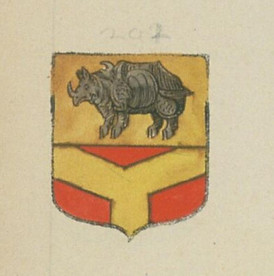
Armoral d'Hozier Province 1696
RHINOCEROS ON COAT OF ARMS
The Etymology of Scotland:
The name Scotland literally translates to "The Land of Scota."
• The Hebrides and Hibernia: The islands off western Scotland (the Hebrides) and the ancient name for Ireland (Hibernia) share their phonetic root with Heber or Eber, the biblical patriarch of the Hebrews [Charles 2020]. They were not primitive tribal settlers; they were Nile Valley royalty carrying their advanced spiritual, mathematical, and governing traditions directly to the edge of Western Europe.

Coat of arms featuring the Cross of Saint George, according to the *Armorial of Aragon* by Gaspar de Torres. Provincial Historical Archive of Zaragoza, 1536.
The True Composition
The historical records of the 711 CE crossing of the Strait of Gibraltar—led by the Berber general Tariq Ibn Ziyad—demonstrate that the Moorish forces were a multi-ethnic coalition. It comprised indigenous Amazigh (Berbers) of North Africa, Melanated Arab elites, and massive detachments of black Africans primarily from West Africa (the regions of ancient Mali, Senegal, and Ghana).
In the 8th century, contemporary Christian European chroniclers universally categorized Tariq and his forces as Moors (Mauri), a term derived from the Latin Maurus, used explicitly to describe dark-skinned African populations. In prominent medieval European literature written shortly after—such as the French epic The Song of Roland—the Moorish forces are explicitly described as being "blacker than ink" and having "no part white except their teeth."